How to Identify Premiumization and Commoditization in AI Development Services
A practical framework for procurement and enterprise buyers to distinguish premiumized vs commoditized AI development services, assess pricing power, and negotiate smarter contracts.
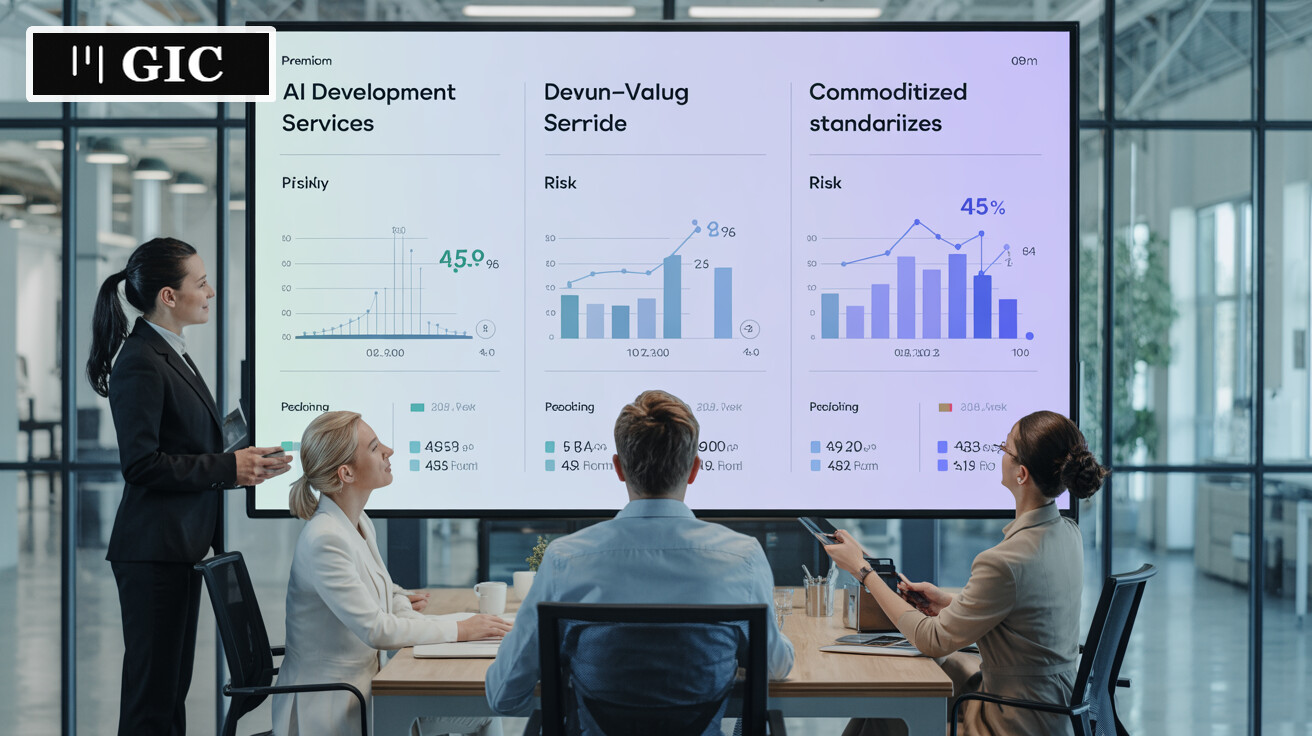
Direct answer
What you need to know
To identify premiumization vs commoditization in AI development services, segment offerings by problem complexity, IP ownership, talent scarcity, and level of customization. Premiumized services typically deliver differentiated business outcomes, proprietary methods or accelerators, higher-touch governance, and scarce specialist talent—justifying higher margins. Commoditized services show interchangeable skills, standardized delivery, repeatable patterns, and intense price competition. Procurement and vendor managers should track market signals such as rate convergence, RFP behavior, reusable components, platform automation, and client risk tolerance across each AI use case to decide where to pay for premium value and where to push for utility-style pricing.
Key takeaways
- Premiumization in AI services clusters around complex, high-risk, and strategically differentiated use cases tied to measurable business outcomes.
- Commoditization shows up where AI work is repeatable, tool-driven, and easily supplied by many vendors with similar skill profiles.
- Mapping each AI initiative by complexity, risk, and reusability helps decide which elements should be premium vs standardized.
- Day rates alone are noisy; margin and pricing power are better inferred from talent scarcity, IP ownership, and delivery leverage.
- Platform automation and reusable accelerators steadily shift previously premium AI work into more commoditized categories.
- Strong procurement strategies unbundle scopes to negotiate aggressively on commoditized components while protecting premium work quality.
- Regional cost differences mask but do not eliminate structural premium vs commodity dynamics in AI labor and delivery models.
- Ongoing market monitoring is needed as AI tools, regulations, and skill supply change what is considered premium year by year.
Why premiumization vs commoditization matters in AI development services
AI development services do not form a single, uniform market. They range from highly bespoke, expert-driven work to repeatable, tool-led tasks. For procurement leaders and enterprise buyers, recognizing where each service sits on the premium–commodity spectrum is essential to avoid overpaying and to ensure critical projects are not under-specified or underfunded.
Premiumization occurs when a vendor can credibly command higher prices and margins. This is usually due to scarce expertise, differentiated intellectual property (IP), or superior risk management that substantially improves business outcomes.
Commoditization occurs when services become interchangeable. Many vendors can deliver similar outcomes using similar approaches, which creates intense price competition and squeezes margins.
In AI development, these dynamics are especially fluid. Techniques, tools, and platforms mature quickly, pushing once-advanced capabilities into the commodity layer, while new frontier models and complex integrations appear at the premium end.
What premiumization and commoditization mean in the AI services lifecycle
Typical AI development service categories
Most AI engagements combine several categories of work:
- Strategy and discovery – use case ideation, value sizing, feasibility assessment, ROI and risk analysis.
- Data and architecture – data discovery, cleansing, feature engineering, architecture design, governance setups.
- Model development – model selection or prompt engineering, training, evaluation, experimentation.
- Integration and productization – embedding AI into workflows, apps, channels, and user experiences.
- MLOps and operations – monitoring, retraining, performance management, and support.
- Change, risk, and compliance – responsible AI frameworks, impact assessment, and regulatory alignment.
Each of these can be premiumized or commoditized depending on context, maturity, and the specific use case. For example, basic chatbot setup on a mature platform is heavily commoditized; a safety-critical diagnostic model integration in healthcare is closer to the premium end.
Where value and margins tend to concentrate
Across markets, higher margins in AI services most often appear where:
- The business problem is complex and high stakes (e.g., risk management, pricing, clinical decisions).
- AI capabilities are strategic differentiators rather than utilities (e.g., personalization engines, proprietary recommenders).
- There are regulatory, ethical, or safety concerns requiring robust governance.
- Vendor teams bring deep domain expertise combined with technical skills.
- Vendors own or control proprietary accelerators, models, or frameworks.
Commoditization appears where:
- Tasks are repeatable and process-driven.
- There is a large global pool of similar skills (e.g., common data engineering tasks).
- Cloud platforms or tools offer managed services that replace custom build.
- Clients perceive limited risk or strategic differentiation from the capability.
A practical framework to classify AI services: premium vs commodity
To evaluate any AI service or proposal, segment it along four dimensions. This provides a structured way to identify which elements you should pay premium rates for and where to push for utility-style pricing.
1. Problem complexity and business criticality
Ask two questions:
- How complex is the technical problem? (data quality, nonlinearity, model behavior, need for experimentation)
- How critical is the business outcome? (revenue, cost, compliance, safety, brand impact)
Premium-leaning signals:
- Unstructured or messy data across many systems.
- Need for novel model architectures, advanced optimization, or combining multiple AI techniques.
- High financial or reputational downside if performance degrades.
- Strong executive sponsorship and board-level visibility.
Commodity-leaning signals:
- Well-defined, repeatable tasks that resemble existing reference cases.
- Limited downside if the AI output is imperfect (e.g., internal productivity helpers).
- Ability to use off-the-shelf SaaS or cloud services with minimal customization.
2. Reusability and standardization potential
Services that create reusable assets or follow highly standard patterns tend to be commoditized over time.
Premium-leaning signals:
- Custom logic tightly bound to your proprietary data and processes.
- Outcome depends heavily on deep understanding of your domain or customers.
- Limited applicability of code or models across clients; unique context is critical.
Commodity-leaning signals:
- Work creates generic components (e.g., data ingestion pipelines on common cloud stacks).
- Vendor reuses the same templates, patterns, and code bases across many clients.
- Cloud providers already offer similar managed solutions (e.g., text classification, translation, standard recognition tasks).
3. Talent scarcity and skill pyramid
Premiumization is strongly linked to talent scarcity. Examine the delivery team structure and market supply of similar profiles.
Premium-leaning signals:
- Material dependence on senior AI scientists, solution architects, or domain specialists.
- Proven experience with large-scale deployments in your industry.
- Vendor cites peer-reviewed research, patents, or recognized contributions to AI methods or tooling.
Commodity-leaning signals:
- Delivery relies mostly on mid-level engineers following established playbooks.
- High staff interchangeability; minimal impact from individual team members rotating off.
- Simple upskilling pathways; similar skills widely available via general training programs.
4. Governance, risk, and compliance intensity
AI used in regulated or sensitive domains often requires dense governance layers, increasing value of high-quality providers.
Premium-leaning signals:
- Use cases in regulated sectors (e.g., financial services, healthcare, public sector).
- Need for explainability, auditability, bias assessment, and model documentation.
- Vendor offers structured frameworks for responsible AI, validation, and monitoring.
Commodity-leaning signals:
- Internal, non-customer-facing use cases with low external risk.
- Basic reviews sufficient; no sophisticated risk controls or model documentation required.
- Limited need for legal or compliance involvement.
Market signals that an AI service is becoming commoditized
Premium today does not mean premium in three years. Procurement and analyst teams should watch for market-level signals indicating that a category is moving toward commoditization.
1. Convergence of rates and proposals
- Average day rates or hourly rates for certain roles plateau or converge across vendor tiers and regions.
- Multiple vendors propose near-identical architectures, timelines, and resource plans for the same use case.
- RFPs attract a wide vendor response with only marginal differences in technical approach.
2. Platformization and automation
- Cloud providers introduce managed AI services that handle previously custom tasks (e.g., MLOps platforms, pre-trained models, low-code AI services).
- Tool vendors launch reusable components and templates that reduce custom coding.
- Vendors increasingly highlight their own internal automation, accelerators, and code generators reducing manual effort.
As platforms absorb more of the complexity, remaining custom work becomes simpler integration and configuration activity, usually with lower margins.
3. Growth of standardized certifications and curricula
- Industry-recognized training programs and certifications emerge around specific AI roles and tools.
- Universities and bootcamps scale programs that directly feed common AI engineering and data roles.
These developments indicate that skills are becoming codified and more widely available, a typical precursor to commoditization.
4. Shifts in contract structures
- Clients push vendors toward outcome-based or fixed-fee engagements for previously T&M work.
- Rate cards for certain roles face consistent downward negotiation pressure year over year.
- Procurement starts to mandate preferred tools, architectures, or patterns, reducing vendor differentiation.
Signals that an AI service retains premium characteristics
1. Clear, referenceable business impact
Premium AI services usually demonstrate a track record of measurable impact:
- Case studies with quantified uplift in revenue, cost savings, or risk mitigation.
- Ability to link models to key performance indicators and decision processes.
- Executive testimonials in your industry, not just technical proof-of-concepts.
2. Strong IP and proprietary assets
Vendors protecting the margins of premium services often invest in IP that is difficult to replicate quickly:
- Proprietary feature stores, model libraries, or optimization frameworks.
- Pre-built domain ontologies, data models, or industry-specific accelerators.
- Reusable prompt libraries or fine-tuned foundation models tailored to particular verticals.
These assets help them deliver faster or better outcomes than generic providers using only public tools, which supports premium pricing.
3. Domain-specific expertise and integrated teams
Premium AI vendors often field integrated teams combining:
- Domain experts (e.g., risk officers, clinicians, product managers) who understand business context.
- AI specialists and engineers with experience in similar use cases and environments.
- Change management, UX, and operations experts to ensure adoption and performance.
This combination is harder to source from purely technical providers focused only on coding and basic model development.
4. High client switching costs
Premium services frequently embed themselves deeply in your processes and decision-making:
- AI models and tooling integrated with multiple internal systems and workflows.
- Complex governance, monitoring, and retraining frameworks tuned to your environment.
- Vendor teams co-designing business processes, not only delivering technical artifacts.
High switching costs generally support more stable pricing and margins for the vendor.
Regional and sourcing considerations
Global AI talent is unevenly distributed, and cost structures differ by region. These factors can mask or exaggerate premium vs commodity dynamics.
Nearshore, offshore, and multi-shore models
- Nearshore and onshore hubs often specialize in higher-value consulting, architecture, and regulatory-sensitive work where close collaboration and language or time-zone alignment matter.
- Offshore hubs frequently focus on large-scale engineering, data preparation, and run services that lend themselves to standardization.
However, some offshore centers now also host deep AI research and advanced development capabilities, providing premium-skilled teams at lower nominal rates. Procurement teams should focus less on geography labels and more on the actual skill composition and project role of each location.
Local regulatory environments
Emerging and evolving AI-related regulation in regions such as the EU and sector-specific rules in finance and healthcare can elevate governance-heavy AI projects into the premium category, especially when combined with cross-border data residency and privacy requirements. Buyers must account for regional compliance capabilities when benchmarking vendors.
Common mistakes when interpreting premiumization vs commoditization
Mistake 1: Equating high cost with premium value
High rates or large budgets do not automatically indicate a premium service. Sometimes they reflect inefficient delivery, bloated teams, or weak scope control. True premiumization is about incremental value over alternatives, not absolute cost.
Mistake 2: Assuming all AI is premium by default
Because AI is associated with advanced technology, some stakeholders implicitly treat all AI work as high-end consulting. In reality, much AI implementation consists of standardized engineering and integration tasks that behave like other IT services markets, increasingly subject to commoditization.
Mistake 3: Ignoring the split within one engagement
Within a single AI project, strategy and model design may be premium, while data labeling and basic MLOps setup are commoditized. Neglecting to unbundle these components leads to blended pricing that hides negotiation opportunities.
Mistake 4: Over-indexing on current tools and underestimating change
New generative AI tools, automated ML platforms, and low-code capabilities can rapidly reduce manual work in activities that were recently labor-intensive. Contracts locked for multiple years without flexibility may leave buyers paying premium prices for tasks that become more automated over the contract term.
Questions to ask vendors to uncover premium vs commodity elements
Use targeted questions during RFPs, orals, and negotiations to reveal where vendors genuinely add differentiated value versus where they follow standard playbooks.
Questions about differentiation and IP
- Which parts of your proposed approach are unique to your firm or your IP?
- How often have you reused this architecture or pattern in other client projects?
- What proprietary accelerators or models will you use, and how do they change cost, speed, or outcomes?
- What is your policy on our use of and rights to any accelerators or IP in this project?
Questions about talent and team composition
- How many engagements like this has the proposed lead architect delivered in our industry?
- What percentage of effort will be delivered by senior AI experts vs mid-level or junior staff?
- Which tasks will be performed in each geography, and why?
- How do you ensure continuity if key experts roll off the project?
Questions about governance, risk, and outcomes
- How will you document and test model performance, fairness, and robustness?
- What is your experience dealing with regulators or auditors in our sector?
- How do you link technical metrics to business KPIs, and how often do you report them?
- What are common failure modes you have seen in similar projects, and how will we avoid them?
Designing RFPs and SOWs that reflect premium vs commodity reality
Procurement can deliberately structure demand so that premium components are recognized and protected, while commoditized elements are opened to stronger price competition.
1. Unbundle workstreams and roles
Instead of a single aggregated AI RFP, separate workstreams such as:
- Discovery and value-case design
- Data engineering and platform setup
- Model development and experimentation
- Integration and change management
- Run, optimization, and support
For each workstream, set expectations on:
- Required skill profiles
- Governance and documentation standards
- Service levels and success metrics
- Preferred commercial model (T&M, fixed, outcome-linked, capacity-based)
2. Use different competition strategies per workstream
- For premium workstreams (e.g., strategy, critical model design), shortlist a smaller set of high-caliber vendors and evaluate them on expertise, references, and impact track record as much as on price.
- For commodity workstreams (e.g., data labeling, standardized integration), open competition to a wider vendor pool, use clear unit pricing, and emphasize SLAs and transition flexibility.
3. Align pricing models with value and risk
- Premium activities may justify higher rates but can also be linked to milestones or outcome-based bonuses to align incentives.
- Commoditized activities often work well under fixed or unit-based pricing with strict performance measures.
4. Guard against creeping premiumization
Over time, vendors may position previously standardized work as specialized due to new branding or minor technical updates. Periodically reassess scopes with internal experts and external benchmarks to keep pricing aligned with market reality.
Using market intelligence to benchmark AI services pricing and margins
Because AI services markets are young and fast-moving, historical IT services benchmarks often misrepresent where margins sit today. Effective benchmarking combines:
- Role-based rate comparisons across vendors and regions, adjusted for skill definitions and seniority.
- Project outcomes and references – not only costs, but delivered ROI and time-to-value.
- Platform and tool maturity – understanding which tasks are now well supported by cloud services or open-source libraries.
- Regulatory and sector dynamics – sectors with intense scrutiny often sustain higher-value governance-related services.
External research from multilateral organizations, research firms, and sector regulators can help situate your negotiations within broader shifts in AI skills supply, adoption, and required safeguards.
Checklist: deciding when to pay premium and when to push for commodity pricing
Before finalizing an AI development contract, run through the following checklist:
- Have we broken the project into discrete workstreams (strategy, data, model, integration, operations)?
- For each workstream, have we rated business criticality, technical complexity, and regulatory or reputational risk?
- Do we understand where the vendor is using proprietary IP vs generic tooling and reference architectures?
- Have we assessed the skill mix and location strategy against market availability for similar skills?
- Are we treating governance-heavy and high-visibility use cases as premium, with appropriate quality and oversight requirements?
- Where tasks are repeatable and well understood, have we explored competitive bidding, unit pricing, or alternative delivery models?
- Do our RFP and SOW make the distinction between premium and commodity elements explicit in scope and pricing?
- Have we considered how tool and platform evolution over the contract period might shift certain workstreams toward commoditization?
Next steps for procurement, vendor management, and strategy teams
Premiumization and commoditization in AI development services are not static labels; they are moving targets shaped by technology, talent, regulation, and client demand. To build a resilient sourcing strategy:
- Create an internal taxonomy of AI services aligned to your use cases, mapped to premium vs commodity attributes.
- Standardize evaluation templates for AI proposals that explicitly capture complexity, risk, IP, and talent scarcity.
- Maintain a live view of AI vendor capabilities across regions, sectors, and service categories, revisiting at least annually.
- Integrate finance and risk teams into major AI sourcing decisions to align spend with value and safeguard critical areas.
- Experiment with hybrid commercial models combining premium pricing where justified with commodity-style arrangements where work is interchangeable.
If your team needs a market view tailored to a specific industry, region, segment, competitor landscape, or investment question, Global Intelligence Catalyst can help with a custom market intelligence report: https://varenyaz.com/contact/
By systematically distinguishing premium from commoditized AI development services, procurement leaders and enterprise buyers can negotiate more effectively, allocate expert attention where it matters most, and reduce the risk of both overpaying for standardized work and underinvesting in strategically decisive AI initiatives.
Practical checklist
- List all AI initiatives and break them into distinct workstreams (strategy, design, build, integrate, operate).
- Rate each workstream on business criticality, complexity, and regulatory or reputational risk.
- Assess how reusable the solution, code, or assets are across business units or use cases.
- Compare vendor proposals: check how differentiated architectures and approaches actually are.
- Identify where vendor teams rely mostly on configuration and reference solutions rather than original design.
- Check skill mix and pyramid: percentage of senior AI specialists vs mid-level and junior engineers.
- Ask vendors to separate IP-heavy accelerators and proprietary components from generic implementation labor.
- Benchmark proposed rates against internal data and market intelligence for comparable roles and regions.
- Decide which workstreams warrant premium partners and outcome-linked pricing vs strict rate-based deals.
- Reflect these decisions in RFP structure, SOW language, and contract terms, including SLAs and governance.
Frequently asked questions
What is the difference between premiumization and commoditization in AI development services?
Premiumization in AI development services occurs when vendors can justify higher prices and margins based on differentiated expertise, proprietary methods, or superior risk management that materially improve business outcomes. Commoditization occurs when similar services are widely available from many providers with little perceived differentiation, leading to standardized offerings, intense price competition, and pressure on margins.
Which AI development activities are most likely to be commoditized?
Activities that are standardized, repeatable, and tooling-intensive tend to be commoditized. Examples include data labeling at scale, basic ML model training using standard architectures, routine MLOps setup on common cloud platforms, simple chatbot deployment, and ongoing model monitoring where clear playbooks and automation already exist. These are often delivered by large pools of similarly skilled engineers or offshore teams, which constrains pricing power.
When is it worth paying premium rates for AI development services?
Premium rates are typically justified when the AI initiative addresses a complex, high-value, or high-risk business problem where failure is costly or highly visible. This includes new revenue-generating AI products, safety- or compliance-critical use cases, large-scale personalization engines, or AI systems that heavily impact customer experience and brand. In these situations, vendors offering deep domain expertise, strong governance, and proven impact can legitimately command higher margins.
How can procurement teams detect hidden commoditization in AI vendor proposals?
Procurement teams can detect hidden commoditization by looking for heavily standardized statements of work, recycled architectures, heavy reliance on cloud provider reference solutions, and large junior-heavy teams for delivery. If multiple vendors propose near-identical approaches and timelines for the same use case, or if much of the work involves configuration rather than genuine design or experimentation, the underlying service is likely commoditized and open to tighter price competition.
How fast do AI development services move from premium to commoditized?
: "AI services often move from premium to more commoditized states over a few years as methods, open-source models, and cloud platform services mature. Early stages of a new AI capability—such as applying frontier models or novel architectures—tend to be high-margin and expert-driven. As best practices stabilize, documentation spreads, and training programs scale, a larger talent pool emerges and platforms automate more steps, which gradually compresses margins on once-premium services."
How should enterprise buyers adjust contracts for premium vs commoditized AI work?
For premium AI work, contracts should emphasize outcome alignment, senior expert access, and strong governance, with some flexibility in scope and iterative learning. For commoditized AI work, contracts should focus on unit rates, service levels, transition flexibility, and clear performance metrics. Unbundling these two types of work in your SOWs and rate cards allows you to pay for value where it matters and apply more rigid commercial discipline where work is interchangeable.
Sources
Related terms
GIC advisory
Need a decision-ready market view?
Global Intelligence Catalyst helps teams turn market signals, buyer evidence, and competitive context into focused research briefs, sizing models, and go-to-market decisions.
Talk to GIC