
A security team with more budget may hire analysts, replace an existing product, expand a platform licence or commission a managed service. These choices create different opportunities for vendors. The starting point is the control gap the buyer needs to close, together with the responsibility and budget assigned to it.
This analysis follows that decision from risk outcome to external procurement and renewal. NIST and CISA provide control context; issuer disclosures clarify the commercial measures. The evidence is limited to material available by the end of 2025 and does not estimate a universal share of security budgets.
Find the funded control gap
“Cybersecurity budget” can refer to a chief information security officer's operating plan, an infrastructure team's cloud allocation, a business unit's resilience project, a regulatory remediation program, or a managed-service contract. A headline can combine people, software, hardware, consulting, insurance, training, and incident costs. The payer, approval path, and time period can differ for every line.
Write down the decision before collecting a market total. A useful statement names the exposed business process, the control outcome, the period, and the owner: “fund identity assurance for privileged users in the next operating plan” is testable. “Enterprise cyber spend” is not. It says nothing about whether the incremental dollar is retained by the buyer, paid to a platform, consumed through a cloud bundle, or sent to a specialist.
Use explicit units throughout the ledger:
- Risk priority: the exposure, regulation, resilience goal, or incident lesson that triggers work.
- Internal cost: employees, training, process, governance, and opportunity cost retained by the buyer.
- External spend: a product, subscription, hardware item, cloud service, consultancy, or managed operation bought from a supplier.
- Supplier metric: bookings, annual recurring revenue, net retention, recognized revenue, billings, cash, or remaining obligation under the issuer's definition.
- Reachable capture: the subset a named vendor can win after technical fit, qualification, channel, timing, and budget approval.
These units can describe one program without being added together. A larger risk program may have more internal work and a smaller software invoice if the enterprise builds the capability itself.
Ask whose budget is growing and why
Budget growth is meaningful only after the budget owner and driver are identified. A regulated bank may add identity controls after an audit finding. A manufacturer may move detection into a managed security operations center because it lacks specialists. A software company may consolidate endpoint and identity tools to reduce operational complexity. A public agency may fund resilience work through a capital program rather than the security cost center.
The trigger changes the likely buying path. A compliance deadline can create a defined project and a short implementation window. A persistent skills shortage can produce a recurring managed-service contract. A severe incident can accelerate emergency response work while delaying a long platform consolidation. A board-level resilience objective can spread funding across network, data, application, and business-continuity owners.
Record five fields for every claimed growth signal:
- budget owner and approving executive;
- risk or control outcome;
- funding type and fiscal period;
- internal versus external delivery plan; and
- supplier, contract vehicle, and decision date.
If one of these fields is missing, retain the signal as a research lead rather than an addressable market value. The absence is especially important when an analyst is converting a survey response or a management comment into revenue.
Separate internal capability from purchased protection
The largest response to a threat may be a team decision. Hiring detection engineers, rotating incident responders, writing policies, testing recovery, and training staff consume budget while generating no vendor revenue. Internal labor can also substitute for a product or reduce a managed provider's scope. Conversely, an enterprise may outsource routine monitoring while keeping architecture and risk acceptance in-house.
Use a delivery ledger with an owner for each control activity:
Scroll horizontally to compare all columns.
| Delivery layer | Typical work | Evidence of external spend | Capture implication |
|---|---|---|---|
| Governance and risk | policy, risk acceptance, audit response | statement of work or advisory invoice | often internal or project-based consulting |
| People and operations | analysts, engineering, incident rotation | staffing, outsourcing, or managed-service agreement | recurring only when the operating scope is contracted |
| Identity and access | authentication, privilege, lifecycle, access review | subscription, implementation, and usage terms | platform capture depends on users, applications, and tier |
| Endpoint and workload | prevention, detection, response, device coverage | license, endpoint count, or service schedule | endpoint growth can be offset by consolidation |
| Network and cloud | segmentation, edge, posture, traffic controls | appliance, cloud service, or bundled platform terms | infrastructure may be embedded in a broader contract |
| Data and application | classification, protection, testing, code security | software, services, and acceptance milestones | product value can depend on data and developer adoption |
| Recovery and response | backup, forensics, crisis response, exercises | retainer, incident fees, or managed recovery | episodic work is not recurring run rate |
The table is a classification tool, not a claim that each layer receives a fixed share of a budget. Count a line as external only when a contract, invoice, usage record, or named provider supports it. A larger internal team can improve security while shrinking the external opportunity.
Use CISA and NIST to classify control demand
The NIST Cybersecurity Framework 2.0 organizes outcomes around Govern, Identify, Protect, Detect, Respond, and Recover. The CISA Cross-Sector Cybersecurity Performance Goals offer a voluntary baseline of high-impact practices and describe how goals can align with the NIST functions. These sources help an analyst classify the problem being funded; they are not surveys of total cyber spending and do not create a supplier forecast.
Map the buyer's request to an outcome before mapping vendors. Govern and Identify work may produce policy, asset inventory, risk analysis, and architecture services. Protect can create identity, endpoint, application, data, and network-control purchases. Detect and Respond can create telemetry, analytics, incident response, and managed monitoring. Recover can create backup, resilience testing, crisis support, and restoration work.
The same product can support several functions, and a single contract can bundle them. Preserve the buyer's stated outcome and the supplier's contract boundary. Do not assign a vendor's entire platform revenue to one NIST function just because its marketing page uses the same label.
Products, platforms and recurring customer measures
Cybersecurity buying often moves from a point product to a platform or service, but the commercial unit changes as it does. A product may be licensed by user, endpoint, workload, data volume, or appliance capacity. A platform may bundle several modules under a committed subscription. A managed provider may charge for monitored assets, response coverage, analysts, or a service level. Implementation and incident work may be one-time or milestone-based.
Okta's fiscal 2025 Form 10-K defines dollar-based net retention using annual contract value from the same customer cohort and distinguishes users and solutions. Those definitions support a recurring identity-business analysis. They do not disclose the fraction of a buyer's security budget that becomes externally purchased software, or make a retention percentage interchangeable with recognized revenue.
Palo Alto Networks' 2025 annual report defines next-generation security annual recurring revenue as an annualized value of active contracts and excludes hardware and professional services. It explicitly separates that metric from revenue, deferred revenue, and remaining performance obligations. The definition is useful precisely because it prevents a run-rate measure from being treated as current-period vendor capture.
For each supplier, retain the commercial boundary: products, platform modules, services, hardware, support, consumption, and any exclusions. A larger bundled platform may win more wallet share while making a component-level allocation less observable.
Read ARR, NRR, and revenue as different signals
Recurring metrics answer different questions. ARR or a similar run rate estimates the annualized value of active contracts under the issuer's definition. Net retention describes expansion, contraction, churn, or cross-sell in an existing customer cohort. Recognized revenue follows accounting delivery and may include or exclude services, hardware, and usage. Billings and cash follow invoicing and collection timing.
CrowdStrike's fiscal 2025 Form 10-K describes subscriptions priced by endpoint and module, with subscription revenue recognized over the service term. A change in endpoint coverage or module adoption affects the contract differently from a change in the accounting-period revenue line. This edition does not carry forward retention percentages reported after 2025.
Build a metric bridge instead of a single growth line:
- eligible customer cohort;
- starting recurring run rate;
- new customers and new modules;
- price, volume, and usage changes;
- churn, contraction, or term changes;
- ending run rate;
- recognized subscription revenue; and
- services, hardware, usage, and deferred obligations outside the run rate.
The bridge makes the buyer question visible. If the issue is renewal risk, NRR and contract terms matter. If it is near-term supplier revenue, recognition and delivery matter. If it is an addressable opportunity, the missing fields are buyer count, qualified workloads, price basis, and contract route.
The channel and the wider IT budget
The supplier named in a security program may not be the party that invoices the buyer. Resellers, cloud marketplaces, systems integrators, managed security service providers, and telecommunications operators can package, finance, implement, or operate a platform. The product vendor may report a subscription while the channel owns the commercial relationship and service margin.
Okta's fiscal 2025 filing describes partner relationships, while Accenture's fiscal 2025 filing describes security consulting, integration and operations capabilities. A buyer can therefore commission software and implementation from different commercial layers. Allocate each obligation to the entity paid for it and remove subcontractor or license pass-through duplication when measuring end-customer spend.
Model the path as a transaction graph. For every edge record payer, payee, reseller or marketplace, product or service, term, and revenue boundary. A managed provider's fee can include software, analysts, infrastructure, and margin. Do not add the provider's gross contract value to the software vendor's reported revenue unless the scope and endpoint have been reconciled.
Place security inside broader IT and cloud spend
Security controls are increasingly embedded in infrastructure, identity, developer, data, and cloud operations. A cloud customer may buy a security feature as part of a wider platform commitment. A network supplier may include security functions in a hardware and software bundle. A systems integrator may configure controls while the buyer capitalizes or expenses the underlying infrastructure elsewhere.
Cisco's fiscal 2025 Form 10-K reports product and services categories and discusses AI infrastructure exposure alongside networking and security portfolios. The filing's category boundaries are a reminder that a security-related outcome can appear in a broader supplier segment. A market model should preserve the segment's reported scope and mark the security-specific allocation unavailable when it is not disclosed.
Ask three boundary questions before using an IT-spend estimate:
- Is the security capability a distinct line item, a bundled feature, or an internal control?
- Is the unit a user, endpoint, workload, data volume, appliance, cloud resource, analyst hour, or contract?
- Does the supplier recognize the amount as product, subscription, service, usage, or a remaining obligation?
The answers determine whether the signal can support a supplier opportunity or only a broad technology-spend context.
Renewal economics and revenue timing
Budget approval is an entry event. Vendor capture becomes durable only when the customer adopts, renews, expands, or increases usage. The path can fail after a purchase because deployment is delayed, users are not enrolled, telemetry is incomplete, a platform is consolidated, or a managed-service scope is reduced.
Use a renewal evidence ladder:
- Contract: term, minimums, renewal rights, price protection, and exit clauses.
- Deployment: covered users, endpoints, workloads, applications, or sites actually onboarded.
- Adoption: active usage, policy coverage, detections, response activity, or service-level performance.
- Economic realization: invoiced, collected, recognized, and recurring amounts under the seller's definition.
- Expansion: new modules, additional entities, more assets, higher usage, or a longer term.
Public NRR is a cohort signal, not a buyer-level forecast. A high NRR can coexist with weak new-logo demand, and a low NRR can coexist with a large remediation project. Keep the cohort metric separate from the target buyer's renewal evidence.
Reconcile bookings, billings, cash, and recognition
Timing can make a growing budget and a flat revenue line both true. A multi-year subscription may be signed in one quarter, billed annually, collected on a different schedule, and recognized ratably. A hardware appliance can be recognized when delivered while support and software are recognized over time. A consulting engagement can be recognized at milestones. An incident retainer may remain unused until an event.
Create a period bridge with these columns:
Scroll horizontally to compare all columns.
| Event | Buyer evidence | Supplier evidence | Interpretation |
|---|---|---|---|
| Budget approved | owner, amount, fiscal year, control outcome | none or commentary | authorization, not a purchase |
| Contract signed | scope, term, minimum, renewal | booking or remaining obligation | committed opportunity, not delivered revenue |
| Invoice or bill | billing schedule, credits, taxes | billings and receivables | invoiced value, not necessarily recognized |
| Deployment or usage | assets, users, workloads, service levels | implementation, usage, or delivery record | proof of delivery and adoption |
| Cash collected | payment and working-capital record | cash-flow disclosure | settlement timing |
| Revenue recognized | buyer expense treatment | product, subscription, or services revenue | period-specific supplier result |
| Renewal or expansion | new term, modules, coverage, usage | NRR, ARR, renewal commentary | evidence of durable capture |
The bridge should keep the issuer's definitions intact. Never back-solve a buyer's budget from a supplier's deferred revenue or ARR without a cohort, contract, and scope match.
Define the contestable vendor opportunity
The common shortcuts are predictable:
- Budget plus supplier revenue: adding a buyer's security plan to a vendor's revenue as though they were separate demand.
- Platform plus module: counting a bundled platform and every included module as separate spend.
- Product plus managed service: treating a managed provider's gross fee and the software license inside it as two end-customer purchases.
- Run rate plus revenue: adding ARR or NRR to recognized revenue without a period bridge.
- Security plus IT total: assigning all of a broad cloud, network, or infrastructure segment to cybersecurity.
Use one endpoint for the executive total. Upstream measures can remain in an evidence graph, but the headline should be either the buyer's external spend, a named supplier's contracted value, recognized revenue, or a carefully scoped reachable opportunity. If the allocation is not disclosed, say so. A “not disclosed” cell is stronger than a precise-looking split inferred from a product label.
Apply a buyer-specific capture filter
A vendor can be relevant to the risk without being reachable in the current buying cycle. Filter the opportunity in five stages:
Stage 1 — Eligible need. Confirm the control outcome, affected assets, budget owner, funding period, and decision date.
Stage 2 — Technical fit. Test integrations, data residency, deployment model, telemetry, policy coverage, response workflow, and required skills.
Stage 3 — Commercial access. Check approved-vendor status, marketplace or reseller route, contract vehicle, pricing unit, minimums, and support geography.
Stage 4 — Delivery capacity. Confirm implementation resources, migration effort, service coverage, customer readiness, and acceptance milestones.
Stage 5 — Durable economics. Separate one-time services, recurring subscription, usage, hardware, managed margin, renewal probability, and expansion path.
The output should be a range or a set of cases when evidence is incomplete. A vendor may pass technical fit but fail procurement access. A managed provider may win the service scope while the product vendor records only a channel sale. A budget may be approved but remain internal. Each failure mode changes capture.
A worked allocation of a security budget
The following bridge is deliberately fictional. It demonstrates the calculation structure and does not represent a market share, company forecast, or recommended budget. Every input is invented solely to show how a buyer can separate internal work, external contracts, and renewal evidence.
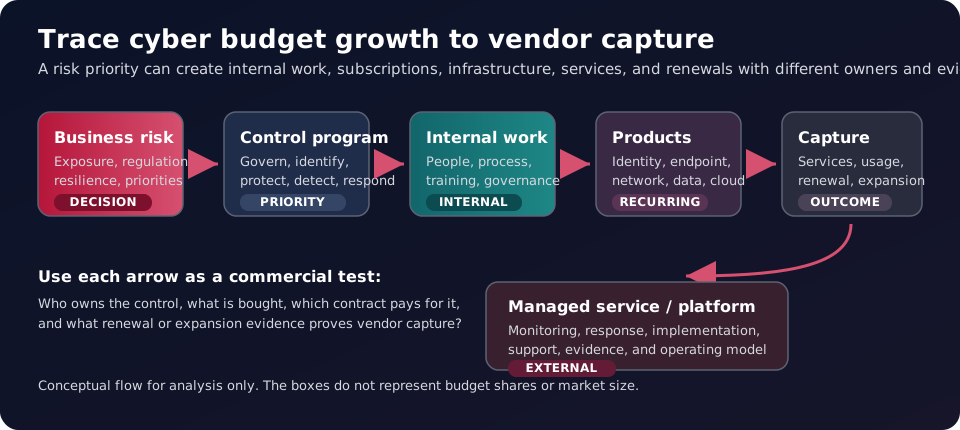
Conceptual budget-to-capture flow for analysis only. The boxes do not represent budget shares or proportional vendor revenue.
Scroll horizontally to compare all columns.
| Risk and control demand | What reviewed evidence can show | What remains unknown without buyer data | Correct role in the model |
|---|---|---|---|
| Risk trigger | CISA and NIST outcomes give a language for the control objective | materiality, owner, deadline, and funded amount | define the decision and priority |
| Internal capability | staffing, governance, training, and operating-model evidence | internal hours, substitution, and opportunity cost | separate retained spend from vendor opportunity |
| Identity and endpoint | Okta and CrowdStrike disclosures show subscription and retention concepts | buyer coverage, price, modules, channel, and renewal | test recurring product fit |
| Platform boundary | Palo Alto Networks defines a run-rate metric distinct from revenue and hardware | buyer cohort, contract scope, and allocation among modules | preserve metric definitions |
| Network and cloud | Cisco reports broader product and services categories that can include security outcomes | security-specific share, bundle price, and cloud allocation | avoid assigning a whole segment to cyber |
| Managed operations | Accenture describes integration and operations capabilities | assets monitored, term, service level, and external share | test recurring service capture |
| Contract timing | filings distinguish bookings, billings, revenue, and obligations | payment, deployment, acceptance, and renewal dates | align period and unit |
| Renewal or expansion | NRR, ARR, new modules, and term commentary are supplier signals | buyer adoption, churn risk, and next decision | validate durable capture |
The table keeps the denominator at the buyer's defined external opportunity. Supplier metrics are evidence about possible capture, not additional rows to add to the budget. A research brief should request the missing contract, coverage, usage, channel, and renewal fields before producing a forecast.
Turn evidence gaps into research questions
Convert each unknown into a question tied to a decision:
- Unknown external share → Which control activities remain internal, and which have an approved external provider?
- Unknown coverage → How many users, endpoints, workloads, applications, or sites are in scope at the decision date?
- Unknown pricing unit → Is the contract priced per user, endpoint, workload, data volume, appliance, analyst, or usage tier?
- Unknown channel → Who owns the commercial relationship, invoice, implementation, and support obligation?
- Unknown adoption → What percentage of assets is onboarded, monitored, protected, or actively using the service?
- Unknown renewal → What term, minimum, expansion option, and exit evidence exists for the next cycle?
The strongest question is specific enough to falsify. “How large is the cyber market?” is too broad. “Which controls in the target region will move from internal delivery to a qualified managed provider during the next renewal window, at what unit price and service level?” identifies a buyer, period, scope, and evidence owner.
Prioritise buyers whose funded control requirement fits the product and whose procurement path is open. For recurring offers, test deployment, renewal and expansion in the same customer cohort. That makes a larger security budget useful to sales and investment decisions without assuming that the entire increase reaches an external vendor.
Discuss the evidence you need
Define the market, geography and questions your research must answer.
Sources
- NIST: Cybersecurity Framework 2.0
- CISA: Cross-Sector Cybersecurity Performance Goals
- Okta: 10-K for the year ended 2025-01-31 (filed 2025-03-05)
- CrowdStrike: 10-K for the year ended 2025-01-31 (filed 2025-03-10)
- Palo Alto Networks: Annual Report for the fiscal year ended July 31, 2025
- Cisco: 10-K for the year ended 2025-07-26 (filed 2025-09-03)
- Accenture: Form 10-K for the fiscal year ended August 31, 2025