
A clinical procedure can use a reusable system, a single-use device, several consumables or no product from the supplier being studied. The setting and treatment choice matter as much as the activity count. A device-demand study therefore needs a product-use relationship that can be checked at case level.
The analysis below connects source-defined clinical activity to eligible cases, device attachment and procurement. It keeps reimbursement and supplier receipts separate and uses evidence available by the end of 2025. Its numerical example is illustrative and does not estimate clinical utilisation for a real population.
Find the clinical event the source actually counts
Write the counting rule beside every extracted number. “Procedure volume” may mean an encounter containing a procedure code, a claim line, a completed case, a side treated, an episode of care, or a device-use event. Those units can move in different directions. A bilateral operation can produce more code lines than cases. A complex episode can contain several procedures. A database can record a visit without exposing every product used during it.
The AHRQ HCUP Nationwide Ambulatory Surgery Sample overview is an important boundary. NASS produces national estimates of selected ambulatory surgery encounters in hospital-owned facilities, and AHRQ explicitly says it is not designed to estimate the total number of procedures. Repeated procedure codes on one record may not represent repeated procedures. A defensible analysis therefore preserves the source unit instead of relabelling an encounter estimate as a national procedure total.
Record the code set, source owner, reporting year, geography, care setting, payer scope, inclusion rule, weighting method, and whether the count is a stock, flow, claim line, encounter, or episode. If the source does not state one of those fields, mark the interpretation as unresolved. A precise unit with an explicit gap is more useful than a large number with an invisible denominator.
Separate encounter, procedure, episode, and device event
An encounter is a contact with a facility or provider. A procedure is a defined clinical service or intervention. An episode may join preoperative, operative, recovery, and follow-up activity. A device event is a product placement, implantation, use, shipment, or service action. One encounter can contain multiple procedures; one procedure can use multiple devices; one device can serve multiple procedures when it is reusable or capital equipment.
The AHRQ HCUP State Ambulatory Surgery and Services Databases overview describes encounter-level data and notes that the services included vary by state and data year. It also distinguishes hospital-owned facilities from the non-hospital-owned facilities included by some states. Those scope choices affect the relationship between the observed event and the device market a buyer is trying to size.
Use a measurement ledger before modelling:
Scroll horizontally to compare all columns.
| Procedure measure | What the source may observe | Commercial interpretation | What remains unknown |
|---|---|---|---|
| Facility encounter | one ambulatory or outpatient record | a care contact in the defined facility cohort | number and identity of products used |
| Procedure code occurrence | a coded service or classification | clinical activity under the code definition | whether the code maps to one case or several device events |
| Completed case | a treated patient or operative case | an opportunity for an eligible product | device attachment, units, and net price |
| Episode of care | joined treatment and follow-up events | a patient pathway and resource envelope | which supplier captures each step |
| Device-use event | implantation, consumption, or equipment use | product demand at the point of use | whether the event is captured in claims or inventory data |
| Shipment or order | product movement through a channel | sell-in or replenishment signal | sell-through, consignment use, returns, or recognition date |
| Recognized revenue | accounting endpoint under a contract | supplier-reported financial result | procedure count that caused the recognition |
Do not sum rows that describe different events. The correct join keys may include facility, date, procedure family, device identifier, contract, and patient-safe episode key. If the join cannot be proven, show the measures side by side and keep the bridge incomplete.
Care setting and product attachment
The same procedure can have a different product mix, payment rule, and purchasing path in an inpatient hospital, hospital outpatient department, ambulatory surgical center, physician office, or non-hospital facility. A shift from inpatient to outpatient care can increase one setting's volume while the total treated population stays stable. A rise in office procedures may bypass the facility channel a hospital-focused supplier measures.
Separate site of service before comparing periods. Identify whether the source covers hospital-owned facilities, independent ASCs, physician offices, specialty clinics, or a mixture. The HCUP SASD scope is useful for state and market-area work, but its participating facilities and service categories vary by state and year. A trend break may be a coverage change rather than a clinical change.
For each setting, record case mix, anesthesia or sedation, length of stay, operating-room access, purchasing authority, and the product classes normally attached to the procedure. A procedure-volume series without a site-of-service split can hide a margin change, a channel change, or a migration into a lower-priced setting.
Map the device attach rate
The first commercial filter is eligibility: which observed procedures can use the product at all? The second is attachment: among eligible procedures, how often is the product actually selected? The third is unit intensity: how many units, cartridges, implants, or accessories are used per attached case?
A useful structure is:
eligible procedures × device attach rate × units per attached case
Every factor needs a source, a documented assumption, or an unavailable state. A procedure may be eligible for several competing technologies. A device can be used only for a subset of severity, anatomy, age, or clinician-training conditions. A reusable capital system can be present in the room without being used in every case. A disposable can be opened but not implanted, returned to inventory, or consumed as a backup.
Do not infer attachment from procedure growth. If 10,000 eligible cases become 11,000, product demand can fall if attachment drops, remain flat if the device loses share, or rise faster than cases if units per case increase. The product ledger must preserve those drivers separately.
Capital systems, consumables and the coding layer
Medtech revenue has different geometries. A capital system may be sold or installed once and then support many procedures. An implant may be tied to a treated patient or anatomical site. A disposable may be consumed per case, per side, or per step. Accessories, software, maintenance, training, and clinical support can sit on separate contracts and schedules.
Create product families with a commercial role: capital placement, reusable instrument, implant, single-use consumable, accessory, service, software, or training. Then define the event that creates demand. A robotic platform placement is not equivalent to robotic-assisted cases. A navigation system upgrade is not equivalent to new system installations. A procedure count can support the utilization of a placed platform while producing no new capital sale in that period.
If the source reports only procedure categories, leave product-family allocation open. A broad “surgical procedure” total cannot be split into implant, stapling, energy, imaging, and robotics revenue without product-use evidence. A buyer may need a bottom-up product ledger, a claims-to-UDI join, interviews, or supplier filings before a revenue endpoint is supportable.
Treat coding as an observation layer, not a product ledger
Procedure and payment codes describe services, classifications, or billing rules. They are not a manufacturer SKU list. One code can cover products with different prices and technical designs. A code line can contain a unit count that reflects billing conventions rather than the number of devices consumed. Modifiers, bilateral rules, packaged services, and unlisted codes can alter the interpretation.
The FDA AccessGUDID portal provides public device-identification information submitted to the FDA and allows device searches or downloads. A device identifier can help reconcile product identity, model, labeler, or version, but it does not reveal the number of procedures in which a product was used. Claims and inventory still need a defensible join, and the UDI record is not a utilization series.
Use coding as one layer in an evidence stack: procedure and diagnosis codes for clinical activity; site and payer fields for access; UDI or catalog records for product identity; inventory or consignment data for availability; and invoices, contracts, or filings for price and recognition. When one layer is absent, state the resulting uncertainty instead of filling the gap with a category average.
Indication, coverage and payment context
A procedure may be clinically possible but commercially unavailable for a product in the target geography. The product may have a different intended use, require a specific clearance or approval, be limited to a population, or be waiting for a local market authorization. A procedure code does not prove that a product can legally be marketed or used for that indication.
The FDA reminder about device registration and listing states that registration and listing do not denote FDA approval, clearance, or authorization. The FDA 510(k) clearance process describes substantial-equivalence review and distinguishes that comparative pathway from the independent safety-and-effectiveness standard used for PMA. Treat registration, clearance, approval, intended use, and commercial availability as separate fields.
Build an indication-and-market authorization filter with product identifier, regulatory pathway, jurisdiction, intended use, contraindications, effective date, and status. If the product is not authorized for the procedure or the evidence is unclear, the addressable procedure pool is unavailable. Do not count a regulatory listing as commercial permission.
Reconcile coverage, payment, and packaging
Coverage is a gate; payment is a mechanism; supplier revenue is an accounting endpoint. They should not be collapsed into one reimbursement number. A payer may cover a procedure only for a defined indication, setting, or patient group. A hospital may receive a prospective payment that packages multiple supplies. A qualifying new device may receive temporary pass-through treatment, while another device is included in a bundled payment.
The CMS Medicare coverage determination process distinguishes national coverage determinations from local contractor decisions. The CMS Hospital Outpatient Prospective Payment System groups outpatient services into APCs and describes comprehensive APC packaging and device pass-through rules. The CMS ASC payment-rate addenda publishes quarterly ASC fee-schedule and drug-file addenda.
Use coverage status, payment group, packaging treatment, pass-through status, and site-of-service rule as distinct fields. A procedure can have high volume and low supplier value when the product is packaged, excluded, or substituted. Conversely, a lower-volume procedure can support a high-value implant or capital system when coverage and purchasing conditions align.
Put payer mix and geography beside volume
All-payer volume is not interchangeable with Medicare volume, and a national rate is not a local contract. Payer mix affects authorization, allowed amount, patient access, site selection, and the share of cases that reach a supplier's target channel. Geography affects practice cost, provider concentration, travel, distribution, and the availability of trained clinicians.
The CMS Physician Fee Schedule documentation shows how relative value units, geographic practice-cost indexes, facility status, and conversion factors shape physician-service pricing. Those payment fields describe a Medicare service payment calculation; they do not state the net price of a device manufacturer or distributor.
Keep payer, locality, site, and product mix in the same analytical grain. If a procedure grows in a region where the product is not contracted or clinicians are not trained, the supplier's addressable volume may not grow. If a procedure migrates to an ASC with a different supply package, the case count can rise while revenue per case falls. Report the local commercial endpoint rather than multiplying a national case total by one national price.
Procurement, inventory and replacement demand
List price is not realized price. A medtech supplier may sell directly, through a distributor, under a group purchasing organization agreement, on consignment, or through a health-system contract. Rebates, returns, chargebacks, tender awards, volume tiers, and value-analysis decisions can change the net amount. A procedure-volume increase can therefore coexist with flat or lower revenue.
Build a price bridge with list price, contracted price, distributor or GPO deductions, rebates, returns, freight, and any variable consideration. Keep the buyer's paid amount separate from the provider's reimbursement and the supplier's recognized revenue. A hospital's payment may cover several products and services; the supplier's contract may allocate consideration across device, service, software, or training.
Procurement timing also matters. A capital purchase can be approved in one period, installed in another, and used in a later period. A tender can change price before it changes case volume. A distributor can stock product before a procedure occurs. If contract terms are not available, present net price as a range or leave it unavailable.
Keep inventory and revenue recognition separate
Inventory placed at a hospital is not automatically revenue. Sell-in to a distributor is not the same as sell-through to a provider. Consigned inventory can sit near the procedure site for weeks or months before use. A returned, expired, or unopened item can appear in inventory records without producing a completed case or revenue.
Medtronic's fiscal 2025 Form 10-K describes direct and distributor sales, consignment inventory, and different transfer points: shipment or delivery for many products, installation for certain capital equipment, and use or implantation for consigned products. The filing also distinguishes device-based therapies from services and describes customers that include healthcare systems, providers, distributors, and group purchasing organizations.
Create separate dates for order, shipment, installation, stocking, use, implantation, invoice, payment, and recognized revenue. Then identify the event that belongs in the chosen financial measure. If the buyer is forecasting disposable demand, use consumption or sell-through. If the buyer is evaluating capital placements, use installation and future utilization. If the buyer is reconciling a public company's filing, use the issuer's recognition policy rather than a procedure date.
Account for replacement, upgrades, and services
Procedure volume can support several commercial paths: new system placement, replacement of an aging platform, upgrade of an installed system, incremental instruments, service contracts, software, training, and consumables. These paths have different cycles. A larger installed base may increase recurring consumables and service revenue while reducing near-term capital placements. A technology change can make existing equipment obsolete without changing procedure volume.
Track installed base age, service status, contract renewal, upgrade eligibility, utilization, and replacement trigger. A system may be present but underused because trained staff are unavailable. A replacement may be driven by reliability, interoperability, regulatory change, or a new clinical capability rather than more procedures. Use procedure volume as one driver of utilization, not as a complete replacement forecast.
Capacity and a product-use forecast
Clinical volume is constrained by operating-room slots, staff, anesthesia, referral patterns, equipment access, training, and patient selection. A procedure can grow while a supplier's technology loses share to a competitor, a different technique, or a lower-cost substitute. A procedure can also fall while a supplier gains revenue through a higher attachment rate, increased units per case, or a new product in the remaining cases.
Use adoption evidence beside volume: trained clinicians, active sites, procedure-level product use, conversion from a comparator, learning-curve completion, and reasons for non-use. Record whether a procedure is elective, urgent, or emergency, since scheduling and product choice differ.
Do not treat a procedure forecast as a device-share forecast. The commercial bridge needs a substitution rule: which alternatives are clinically acceptable, which sites can adopt the product, how quickly clinicians can switch, and whether the product changes the procedure itself. If those fields are unknown, keep the revenue endpoint conditional.
Apply a buyer-specific procedure-to-revenue filter
For a medtech strategy, market-access, supplier, or investor decision, test the opportunity in seven stages:
- Procedure boundary: define the case, code, episode, geography, period, setting, payer, and inclusion rule.
- Data coverage: reconcile encounter, claim, facility, and weighting limits; remove duplicates and scope breaks.
- Clinical eligibility: identify the indication, severity, anatomy, intended use, and authorized product set.
- Product attachment: estimate product share, units per case, disposable or implant intensity, and capital utilization.
- Access and economics: test coverage, payment grouping, packaging, payer mix, contract price, discounts, and procurement route.
- Timing: separate order, installation, inventory, use, sell-through, service, and revenue-recognition events.
- Decision threshold: choose the governing output: eligible cases, units, net revenue, recurring revenue, gross margin, installed-base growth, or return on capital.
The output should be a cohort ledger with explicit unavailable fields. “The region performs 40,000 procedures” is an activity statement. “The target cohort contains an evidenced number of eligible cases, a measured attach rate, a defined units-per-case rule, a contracted net-price range, and a recognized-revenue timing policy” is a commercial case that can be tested and updated.
Test a fictional procedure-to-revenue bridge
The following bridge is deliberately fictional. It demonstrates the calculation structure and does not represent a hospital, product, company, procedure benchmark, market size, market share, reimbursement rate, or revenue forecast. Every number is invented solely to show how a buyer can keep clinical activity, device demand, net price, and recognition timing separate.
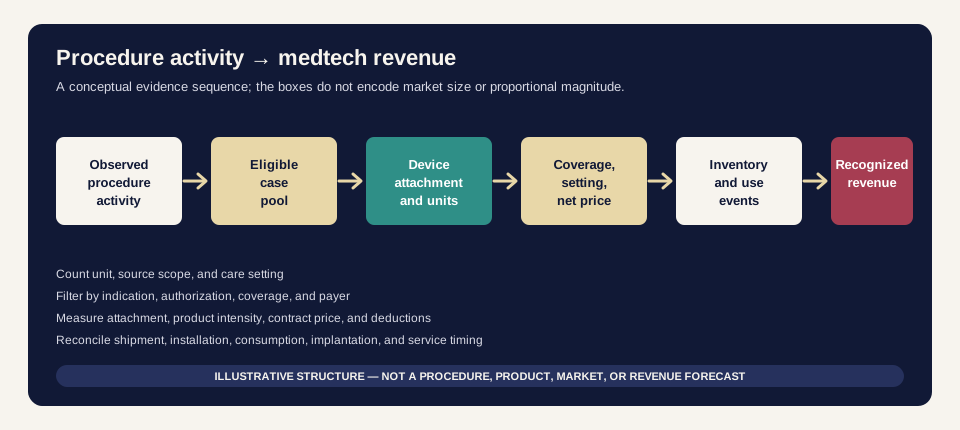
Conceptual procedure-to-revenue flow for analysis only. The arrows show an evidence sequence; they do not show proportional magnitude or forecast confidence.
Scroll horizontally to compare all columns.
| Fictional bridge step | Illustrative input | What it can answer | What it cannot answer |
|---|---|---|---|
| Observed activity | 12,000 coded encounters in the defined outpatient cohort | the source-defined clinical activity | completed cases, product use, or total procedures |
| Eligible case pool | 7,200 cases after indication, setting, and authorization filters | the potential product denominator | attachment, units per case, or supplier choice |
| Product attachment | 34% of eligible cases with the target product family | a product-use scenario | whether the observed rate is measured or assumed |
| Product intensity | 1.3 consumable units per attached case plus 0.1 implant units | an illustrative unit requirement | capital placement, wastage, or replacement timing |
| Net commercial value | 410 currency units per consumed unit after fictional deductions | a net-price scenario | payer reimbursement, margin, or contract validity |
| Recognition endpoint | 70% use or implantation, 20% shipment, 10% service timing | a timing and reconciliation view | actual supplier revenue or future procedure growth |
The fictional calculation would be 7,200 eligible cases × 34% attachment × 1.3 consumable units × 410 net currency units, with the implant and service streams kept separate. It is intentionally not presented as a market result. A real bridge would replace each input with dated claims or encounter evidence, a product-use or inventory join, regulatory and coverage records, contracts, and the supplier's recognition policy.
The next research questions should be explicit: Which facilities and payers are inside the denominator? What share of eligible cases uses the product? How many units are consumed or implanted? Which procedures migrate between settings? What price survives contracting and rebates? When does control transfer? Which installed-base, service, or replacement events sit outside the procedure count? Answering those questions is how a procedure series becomes a medtech revenue analysis without pretending that clinical volume is revenue.
For consumables, validate attached cases and units used per case. For capital systems, investigate installation decisions, replacement cycles and the consumables or service business they support. These require different forecasts even when they begin with the same clinical activity. A case-use audit and matched procurement data usually resolve more than another broad procedure total.
Discuss the evidence you need
Define the market, geography and questions your research must answer.
Sources
- AHRQ HCUP Nationwide Ambulatory Surgery Sample overview
- AHRQ HCUP State Ambulatory Surgery and Services Databases overview
- CMS National Physician Fee Schedule and Relative Value Files
- CMS Hospital Outpatient Prospective Payment System
- CMS Ambulatory Surgical Center Payment Rates and Addenda
- CMS Medicare Coverage Determination Process
- FDA Important Reminders about Device Registration and Listing
- FDA Medical Device Safety and the 510(k) Clearance Process
- FDA AccessGUDID for the public
- Medtronic plc: 10-K for the year ended 2025-04-25 (filed 2025-06-20)