What Cost Pressures Matter Most in AI Development Services?
A practical guide to understanding the main cost pressures in AI development services, how they shape pricing and margins, and what investors, buyers, and operators should monitor to make better strategic and investment decisions.
Direct answer
What you need to know
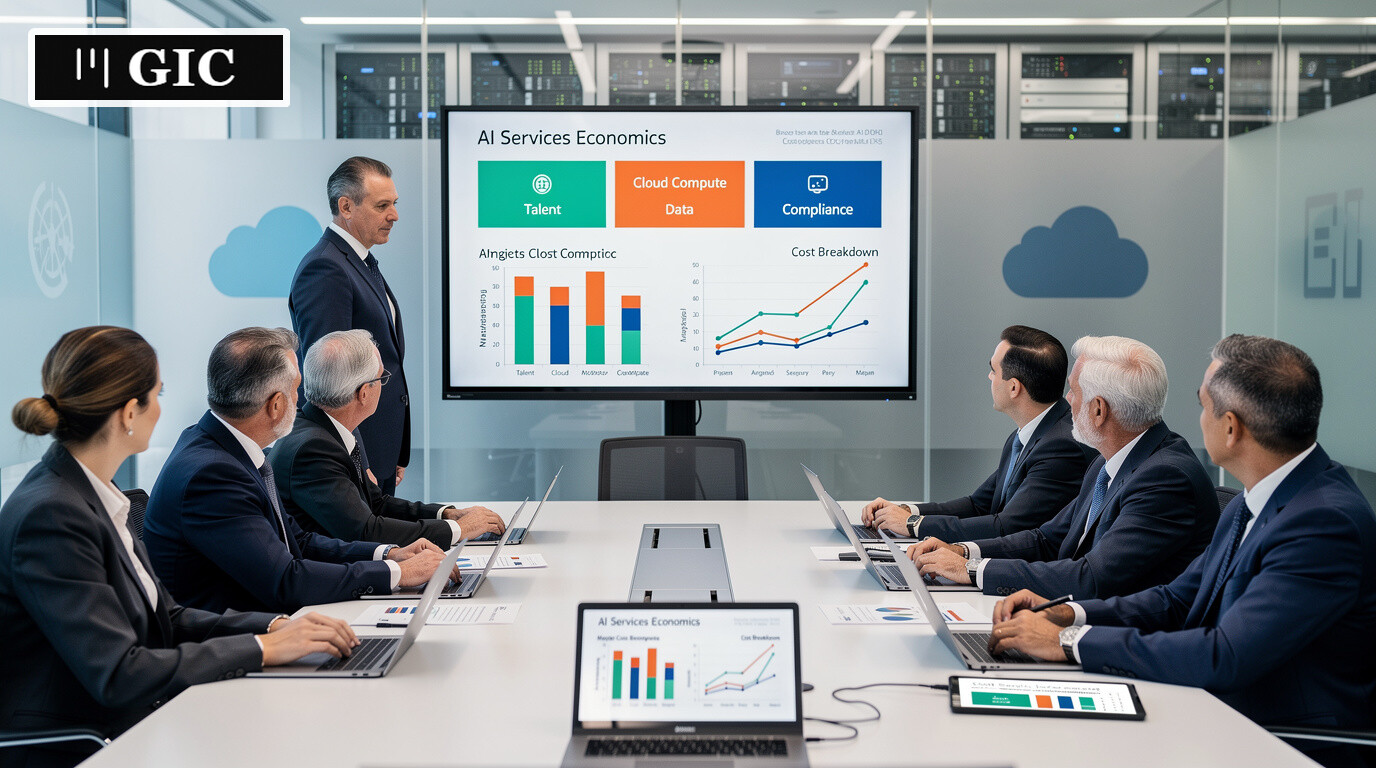
The cost pressures that matter most in AI development services are concentrated in five areas: scarce and expensive talent, escalating compute and infrastructure requirements (especially for training and running large models), rapidly changing software and tooling costs, project and delivery risk from experimentation-heavy work, and rising compliance, data protection, and security overhead. These interact with pricing models and competitive intensity to compress margins, particularly for custom projects. Investors and operators need to track how a provider manages talent mix, cloud and GPU costs, reusable IP, delivery discipline, and regulatory readiness to assess profitability and scalability.
Key takeaways
- AI development services are driven primarily by talent, compute, data, and compliance costs, with talent and compute forming the largest and most volatile components.
- Margins are highly sensitive to provider choices about cloud/GPU strategy, IP reuse, delivery discipline, and pricing model design.
- Custom, experimental AI projects tend to face higher cost risk than productized or repeatable use cases, especially when scoping and data readiness are weak.
- Regulatory, privacy, and security requirements are becoming a material and rising cost center, particularly in regulated industries and cross-border deployments.
- Buyers and investors should distinguish between one-off project economics and the scalable economics of platforms, accelerators, and reusable models.
- Regional labor arbitrage is real but narrowing; high-end AI talent is globally scarce and can quickly erode expected margin advantages.
- Monitoring utilization, win rates on repeat use cases, and dependency on a single cloud or model provider are key to assessing long-term margin resilience.
- Structured checklists and clear questions on cost drivers, contracts, and risk allocation improve both investment DD and procurement outcomes.
Understanding Cost Pressures in AI Development Services
AI development services sit at the intersection of high-value problem solving and highly volatile input costs. For investors, corporate strategy teams, and buyers of AI services, the key question is not just whether AI "works" but whether the economics are sustainable: who bears the risk, what drives margins, and how resilient those margins are as technology and regulation evolve.
This guide breaks down the main cost pressures in AI development services, how they affect pricing and profitability, and what signals decision-makers should monitor when investing in, partnering with, or building AI service capabilities.
The Cost Structure of AI Development Services: A Practical Overview
While individual business models differ, most AI development services share a common cost structure. Understanding this structure is the foundation for evaluating pricing, margins, and scalability.
1. Talent: The Dominant and Scarcest Input
AI development is talent-heavy. Key roles include:
- Machine learning engineers and data scientists for model design, training, and evaluation.
- Data engineers to build pipelines and manage data quality.
- MLOps engineers to deploy, monitor, and maintain models in production.
- Product managers and UX specialists to turn models into usable products.
- Domain experts in fields like finance, healthcare, or manufacturing to ensure relevance and compliance.
These specialists command premium compensation, especially in mature markets. Competition from hyperscalers, large enterprises, and well-funded startups further tightens supply. Even where firms use lower-cost regions, the senior talent that anchors delivery and client trust usually sits at the high end of the wage spectrum.
Why this matters: For most AI service providers, talent is the single largest cost line. Wage inflation, attrition, and under-utilization can quickly erode margins. Investors and buyers should pay attention to the talent pyramid, utilization rates, and the balance between senior and mid-level staff.
2. Compute and Infrastructure: Volatile and Scaling with Ambition
As AI models – particularly generative models – grow in size and capability, compute demand increases sharply. The OECD highlights how access to compute has become a strategic factor in AI competitiveness, with large models requiring significant GPU capacity and optimized infrastructure to remain economical.1
Key cost elements include:
- Cloud compute (CPU, GPU, TPU instances) for training, fine-tuning, and inference.
- Storage and networking for large datasets, model artifacts, and logs.
- On-premises or co-located hardware for firms that invest in their own GPU clusters.
- Licensing or usage fees when using proprietary foundation models via APIs.
Compute costs are highly sensitive to project scope, model choice, and architecture decisions. Poorly optimized training runs or over-sized deployment setups can consume margin unexpectedly, especially under fixed-price contracts.
Why this matters: Providers without strong cloud cost management or volume discounts may see gross margins fluctuate with each large training or fine-tuning engagement. Dependence on a single cloud or model vendor also adds pricing risk.
3. Data, Tooling, and Platforms: Essential Enablers with Hidden Costs
Data is central to AI services economics. McKinsey notes that the impact of AI depends heavily on the availability and quality of data, as well as on the supporting stack of tools and platforms that make AI deployable in production.2
Key cost contributors include:
- Data acquisition (buying datasets, partnerships, data collection infrastructure).
- Data preparation and labeling, often manual or semi-automated for complex domains.
- MLOps and data tooling subscriptions or internal platform engineering.
- Integration costs to connect AI solutions with client legacy systems and workflows.
While often smaller than talent and compute, these costs accumulate across projects. Where data labeling or integration is more complex than expected, overruns can be substantial.
4. Compliance, Security, and Governance: Rising and Uneven by Region
AI regulation and expectations for governance are tightening, especially in the EU, where the AI Act introduces risk-based obligations for high-risk systems, transparency, and oversight.3 Across regions, clients increasingly expect robust information security management and certifications such as ISO/IEC 27001.4
Cost drivers include:
- Data protection and privacy assessments, contracts, and controls.
- Security infrastructure, audits, and certifications.
- Model risk management, documentation, and monitoring.
- Legal and compliance overhead for cross-border data flows and sectoral regulations.
Why this matters: Compliance and governance costs are rising from "back-office overhead" to a strategic cost center, especially for providers serving regulated industries or operating across jurisdictions.
5. Sales, Marketing, and Client Education
Educating clients, running pilots, and co-creating use cases can be time-consuming. In many markets, the sales cycle for meaningful AI engagements remains long, requiring:
- Solution architects and senior experts in pre-sales.
- Proof-of-concept or pilot projects that may be low-margin or subsidized.
- Change management and stakeholder engagement on the client side.
These activities raise customer acquisition costs and delay payback periods, particularly when pilots do not convert to full deployments.
The Cost Pressures That Matter Most: Where Margins Are Won or Lost
Not all cost lines are equally strategic. For most AI development service providers, five cost pressures dominate margin dynamics.
1. Scarce, High-Cost AI Talent
Wage inflation for top AI talent is an enduring pressure. Investors and buyers should focus on:
- Talent pyramid: Is there an over-concentration of expensive senior roles doing work that could be systematized or delegated?
- Global delivery mix: How effectively does the firm use lower-cost regions without sacrificing quality or compliance?
- Attrition and replacement costs: High turnover forces repeated onboarding and knowledge loss, which increases project risk.
- Dependence on key individuals: Single points of failure can destabilize delivery economics.
For investors, a key signal is whether the provider has codified its know-how into playbooks, templates, and accelerators, reducing dependence on a small group of experts.
2. Compute and GPU Costs for Training and Inference
Compute is the second major pressure point, and it becomes more intense as providers:
- Build or fine-tune large foundation models.
- Run high-volume inference workloads (e.g., generative AI in customer-facing channels).
- Operate under SLAs that require low latency and high availability.
Key risk factors include:
- On-demand reliance on cloud GPUs without reserved capacity or negotiated discounts.
- Over-sized architectures (using models or instance types that exceed actual performance needs).
- Usage unpredictability, especially under usage-based client pricing where demand can spike.
Providers that invest in optimization – such as model distillation, quantization, and efficient serving architectures – can mitigate these pressures and build a competitive cost advantage.
3. Project and Delivery Risk in Experimental Work
Many AI engagements remain exploratory. This introduces specific cost pressures:
- Scope uncertainty when business objectives and technical feasibility are not well-defined.
- Data readiness gaps, where cleaning and labeling work are far greater than anticipated.
- Iteration-heavy experimentation that consumes more talent and compute than forecasted.
- Client-side dependencies (access to systems, users, or subject matter experts) that cause delays.
Under fixed-price or outcome-based models, these factors can compress margins sharply. Under time-and-materials models, they may be recoverable but can strain client relationships and delay ROI.
4. Rising Compliance, Security, and Regulatory Expectations
Across jurisdictions, expectations around AI transparency, risk management, and data protection are tightening. The EU AI Act, for example, introduces obligations around risk classification, documentation, and monitoring for certain AI systems.3 Achieving and maintaining certifications like ISO/IEC 27001 requires ongoing investment in processes, tooling, and audits.4
For AI service providers, cost pressures arise from:
- Extensive documentation of models, datasets, and decision logic.
- Third-party audits and certification fees.
- Additional engineering work for explainability, bias testing, and logging.
- Legal review of cross-border data transfers and contracts.
Providers serving multiple high-regulation industries or operating globally face structurally higher compliance cost baselines.
5. Limited Reuse of IP and Accelerators
If each AI project is treated as a one-off, cost pressures accumulate with little leverage. Conversely, providers that successfully turn past work into reusable components can:
- Shorten delivery times and reduce talent hours per project.
- Run more efficient compute footprints.
- Standardize integration and MLOps patterns.
- Command premium pricing for repeatable solutions.
The absence of such IP increases reliance on expensive specialists and makes each project riskier from a margin perspective.
How Cost Pressures Translate into Pricing and Margins
The way providers price their services determines how these cost pressures show up in financial performance.
Common Pricing Models in AI Development Services
- Time-and-materials (T&M): Clients pay for actual hours and infrastructure usage. Providers pass much of the risk on but may face client pushback on escalating invoices.
- Fixed-price projects: Providers commit to deliver scope at a set price. Mis-scoping or data issues can quickly destroy margins.
- Retainer or managed service: Ongoing service with defined scope and SLAs, often blending T&M and fixed elements.
- Usage-based pricing: Fees tied to model calls, transactions, or seats, often layered over compute or API costs.
- Outcome-based or value-based pricing: Fees linked to measurable impact (e.g., cost savings, conversion lift). Potential for high upside but requires mature measurement and cost control.
Margin Dynamics by Offering Type
Different types of AI services exhibit different margin profiles:
- Bespoke consulting projects: High day rates but high delivery risk and limited scalability.
- Productized solutions and accelerators: Lower marginal delivery costs after initial investment; margins improve with volume.
- Managed AI operations (e.g., ongoing monitoring, retraining): Recurring revenue with stable cost base if well-automated.
- API-based services built on third-party models: Gross margins depend heavily on the spread between underlying model/API costs and end-user pricing, plus differentiation.
Investors and buyers should evaluate not only current overall margins but also the mix of offerings and where the firm’s growth is concentrated.
Market Signals and Trends That Amplify Cost Pressure
Certain industry and market trends can intensify or moderate cost pressures in AI development services.
1. Generative AI Adoption and Model Size
The widespread adoption of generative AI has raised expectations for capabilities but also for responsiveness and personalization. Larger and more capable models tend to require greater compute and more sophisticated monitoring, especially when embedded in client-facing workflows. This can:
- Increase GPU and storage needs.
- Raise the bar for observability and content safety tooling.
- Extend experimentation phases to tune prompts, safeguards, and workflows.
2. Cloud Pricing and Vendor Strategies
Changes in cloud pricing structures, egress fees, or model licensing can materially alter cost bases. Vendor incentives to keep workloads in a given ecosystem may conflict with a provider’s desire for portability and price competition.
3. Regulatory Trajectory
Regions moving toward formal AI regulation (e.g., the EU AI Act) will see an uptick in governance, documentation, and audit requirements. Even outside formal regulation, industry expectations – for example, in financial services or healthcare – will drive similar cost profiles.
4. Convergence of AI and Traditional IT Services
Traditional IT services and consulting firms are aggressively adding AI capabilities. This changes:
- Competitive intensity and pricing pressure.
- Client expectations for bundled deals that mix AI with broader transformation work.
- The benchmark for utilization, process maturity, and offshore leverage.
Specialist AI providers with weaker operational maturity may feel margin pressure as larger firms bring more industrialized cost structures to the same opportunities.
Common Mistakes in Interpreting AI Services Cost and Margin Profiles
Decision-makers frequently misread AI service economics. Being aware of these pitfalls can improve investment and sourcing outcomes.
Mistake 1: Treating AI Like Traditional Software Services
AI depends more heavily on data readiness, experimentation, and post-deployment monitoring than typical software projects. Assuming similar scoping, risk profiles, or utilization norms can lead to underestimation of costs and over-optimistic margin expectations.
Mistake 2: Ignoring Compute Risk Under Fixed Pricing
Fixed-price engagements that involve model training or heavy inference without explicit compute budgets invite hidden margin erosion. Contracts should specify who bears compute risk and under what conditions prices can be revisited.
Mistake 3: Overvaluing One-Off Projects vs Reusable IP
Revenue from large, bespoke AI projects can look attractive in isolation but may be hard to repeat and scale. Sustainable economics usually come from turning learnings into reusable solutions that reduce marginal costs for subsequent clients.
Mistake 4: Underestimating Compliance and Governance Overhead
Especially in regulated sectors, the cost of governance is not optional. Underestimating the work required for documentation, model risk management, and audits can lead to chronic overruns and strained client relationships.
Mistake 5: Assuming Regional Labor Arbitrage Solves Everything
While global delivery models can lower average costs, high-end AI talent is scarce everywhere. In practice, savings may be offset by coordination overhead, training, and the need to keep critical design work close to key clients or regulators.
Key Questions Before Entering, Investing, Buying, or Expanding
Whether you are evaluating an acquisition, building an internal AI practice, or selecting a services partner, the following questions help clarify cost pressures and margin resilience.
Strategy and Offering Mix
- What share of revenue comes from bespoke projects versus standardized or productized solutions?
- Which offerings exhibit the highest and most stable gross margins, and why?
- How quickly can the organization turn successful bespoke work into reusable IP and accelerators?
Talent and Delivery Model
- How is talent distributed across regions, seniority levels, and roles (ML, data engineering, MLOps, domain)?
- What are typical utilization rates, and how volatile are they across quarters?
- How does the firm mitigate knowledge concentration in a few individuals?
Compute, Cloud, and Model Dependencies
- What is the provider’s cloud strategy (single, multi-cloud, hybrid) and why?
- How are GPU and model API costs managed and optimized across projects?
- What is the exposure to price changes from a single cloud or model provider?
Data, Tooling, and MLOps
- Which MLOps and data platforms are in use, and how standardized are they across clients?
- How are data labeling and preparation handled, and what percentage of project effort do they typically consume?
- How are models monitored in production for performance, drift, and incidents?
Compliance, Security, and Governance
- Which security and privacy certifications does the provider hold (e.g., ISO/IEC 27001), and how are they maintained?
- How does the provider stay ahead of changing AI regulations in key markets?
- What is the process for documenting models, datasets, and decisions for audit or regulatory review?
Pricing and Contracting
- What is the mix of T&M, fixed-price, and outcome-based contracts?
- How are scope, compute costs, and change requests handled in contracts?
- How are SLAs defined for model performance and availability, and what are the financial implications of breaches?
A Practical Evaluation Checklist for AI Services Cost Pressures
Use this checklist as a structured lens when assessing an AI services provider or a potential investment target:
- Cost base clarity: The provider can clearly break down its cost base into talent, compute, data/tooling, and compliance, with approximate shares and trends.
- Cloud and compute discipline: There is a defined strategy for cloud vendor selection, reserved capacity, optimization, and monitoring of GPU usage.
- Talent leverage: Senior experts are leveraged across multiple projects through playbooks, accelerators, and internal training, rather than embedded full-time in a single engagement.
- IP and accelerators: The provider maintains a catalog of reusable components (e.g., libraries, prebuilt models, integration templates) and can quantify their impact on delivery time and cost.
- Delivery governance: Projects have standardized discovery phases, clear acceptance criteria, and mechanisms for early detection of data or scope risks.
- MLOps maturity: Deployment, monitoring, and retraining processes are automated and standardized, reducing operational overhead per model.
- Regulatory preparedness: There is an explicit framework for AI risk management, alignment with relevant regulations, and readiness for external audit.
- Margin analytics: Management regularly reviews margins by project type, sector, and region, and can explain the root causes of variance.
Next Steps for Investors, Strategy Leaders, and Buyers
Cost pressures in AI development services will intensify as models evolve, regulation tightens, and competition grows. To make better decisions:
- Map your exposure: Identify where your current or planned AI initiatives are most sensitive to talent, compute, or compliance cost shocks.
- Segment providers: Distinguish between generalist consulting, specialist AI boutiques, and platform-centric providers; evaluate each on the relevant cost and margin drivers.
- Structure contracts carefully: Align pricing models with your risk appetite for experimentation versus predictability; make compute and data responsibilities explicit.
- Prioritize reusable value: Favor engagements that produce reusable components, data assets, or capabilities that improve economics over time.
- Monitor regulatory developments: Especially if you operate in or with the EU or regulated industries, anticipate how governance requirements will change costs and timelines.
If your team needs a market view tailored to a specific industry, region, segment, competitor landscape, or investment question, Global Intelligence Catalyst can help with a custom market intelligence report: https://varenyaz.com/contact/
Conclusion: Focusing on the Right Cost Pressures
Understanding what cost pressures matter most in AI development services helps separate durable business models from short-lived hype. Talent and compute remain the core drivers, but their impact depends on the provider’s ability to standardize delivery, reuse IP, manage compliance, and choose appropriate pricing models.
For investors, robust due diligence on cost structure and margin resilience is essential before committing capital. For corporate strategy and procurement teams, clarity on these dynamics leads to better partner selection, more realistic business cases, and stronger negotiation positions.
Ultimately, sustainable AI services economics come from disciplined cost management, clear value articulation, and a strategic approach to converting experimental work into scalable, repeatable capabilities.
Practical checklist
- Map the provider’s cost base across talent, compute, data, tooling, and compliance; identify which two line items dominate.
- Review cloud and GPU contracts: discounts, term commitments, and exposure to on-demand pricing spikes.
- Assess the mix of bespoke projects versus standardized offerings and reusable accelerators in the revenue base.
- Evaluate the AI talent pyramid: ratio of senior to mid/junior roles, use of global delivery centers, and attrition patterns.
- Inspect MLOps and engineering practices for automation, model monitoring, and efficient deployment workflows.
- Check how delivery risk is allocated in contracts (T&M vs fixed-price vs outcome-based) and how change requests are handled.
- Verify the strength of data governance, security controls, and regulatory alignment, especially for cross-border data flows.
- Analyze gross margin trends by project type and client segment to detect where cost pressures are tightening or easing.
- Test the resilience of margins under scenarios of higher cloud pricing, tighter regulation, or slower talent hiring.
- Confirm the presence of executive and board-level oversight for AI risk, cost management, and strategic partnerships.
Frequently asked questions
What are the largest cost components in AI development services?
The largest cost components are typically talent (data scientists, ML engineers, MLOps, domain experts), compute and infrastructure (cloud instances, GPUs, storage, networking), and data and tooling (data acquisition, labeling, pipelines, and MLOps/tooling subscriptions). Compliance, security, and project management add further overhead, especially in regulated industries.
How do cloud and GPU costs affect AI service margins?
Cloud and GPU costs can heavily influence margins, particularly for training or fine-tuning larger models and for compute-intensive inference. Providers that lack volume discounts, reserved instances, or efficient architectures may see volatile or eroding margins. Conversely, those that optimize models, right-size infrastructure, or use hybrid cloud/on-prem setups can stabilize and improve profitability.
Why is talent such a dominant cost driver in AI development?
Advanced AI solutions require scarce skills across machine learning, data engineering, product design, and domain expertise. Compensation for these roles is significantly higher than standard software development, and productivity can vary widely between teams. This makes labor costs the largest and most strategic input, and the main lever for quality, speed, and margin improvement.
How do pricing models influence cost pressure and margins in AI services?
Time-and-materials models pass more delivery risk to the client but can obscure inefficiencies and limit scalability. Fixed-price models increase margin volatility if scope and data readiness are unclear. Outcome-based or usage-based pricing can align incentives but require strong cost control and measurement. The choice of model determines how talent, compute, and project risks translate into realized margins.
What signals indicate that an AI services provider can scale profitably?
Positive signals include a growing share of revenue from reusable IP and accelerators, disciplined project scoping, diversified cloud and model partnerships, strong MLOps practices, clear data governance, and healthy utilization rates without chronic overwork. A history of repeat customers, standardized offerings, and stable or improving gross margins also points to scalable economics.
How should investors and buyers assess regulatory and security-related cost risks?
They should review the provider’s data governance framework, certifications (such as ISO/IEC 27001), incident response processes, and alignment with relevant regulations like GDPR or sector-specific rules. They should also quantify the cost of required audits, documentation, privacy-preserving techniques, and potential rework if regulatory expectations tighten over the contract or investment horizon.
Sources
Related terms
GIC advisory
Need a decision-ready market view?
Global Intelligence Catalyst helps teams turn market signals, buyer evidence, and competitive context into focused research briefs, sizing models, and go-to-market decisions.
Talk to GIC